
Class 8 Science Chapter 11 Keeping Time with the Skies explores how the Moon’s phases change, why calendars were created, how festivals depend on astronomical events, and why we launch artificial satellites.
Since ancient times, humans have looked at the sky to understand time. The daily rising and setting of the Sun, the changing phases of the Moon, and the pattern of seasons helped early people create days, months, and years. By observing the skies, we learn how natural cycles help us measure time even today.
Time with the Skies Worksheet
Our worksheets offer a wide range of practice questions, including MCQs, fill in the blanks, true or false, and short and long answer questions. Carefully aligned with the latest curriculum, these worksheets promote critical thinking through concept-based activities, simple experiments, and real-life applications, helping students build a strong and practical understanding of the topic.
With our engaging and well-structured worksheets, students can reinforce their classroom learning, prepare for exams, and develop a strong foundation in science.
Also download:
Class 8 Social Science Worksheet
Class 8th Science NCERT Solutions Curiosity
Science Class 8 Chapter 11 Study Notes
Changing Appearance of the Moon
- The Moon does not emit its own light; it reflects sunlight.
- Only the illuminated part of the Moon facing Earth is visible.
- Its appearance changes because the Moon revolves around the Earth.
- These changing illuminated shapes are called phases of the Moon.
Phases of the Moon
- New Moon (Amavasya): Moon not visible.
- Crescent Moon: Less than half illuminated.
- Half Moon (Quarter Moon): Exactly half illuminated.
- Gibbous Moon: More than half illuminated.
- Full Moon (Purnima): Entire illuminated side visible.
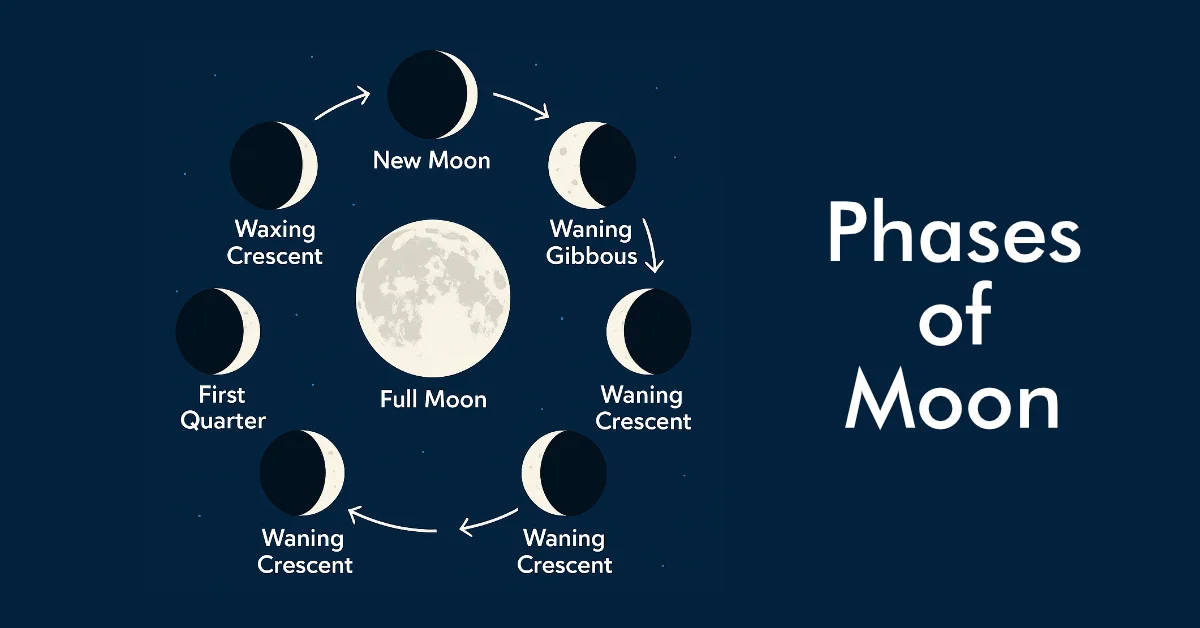
Waxing and Waning
- Waxing (Shukla Paksha): Bright part increases (New Moon → Full Moon)
- Waning (Krishna Paksha): Bright part decreases (Full Moon → New Moon)
- Complete cycle takes 29.5 days, called a lunar month.
- Moonrise and Moonset
- The Moon rises about 50 minutes later each day.
The phase tells us whether to look for the Moon at sunrise or sunset.
Calendars
Calendars help measure long periods of time using natural cycles.
Units of Time
- Day: Time between two successive noons (24 hours).
- Month: One complete cycle of Moon phases (29.5 days).
- Year: One revolution of Earth around Sun (365¼ days).
Types of Calendars
(a) Lunar Calendar
- Based on phases of the Moon.
- 12 months ≈ 354 days → not linked to seasons.
(b) Solar Calendar
- Based on Earth’s revolution around the Sun.
- Gregorian calendar: 365 days, leap year every 4 years.
(c) Luni-solar Calendar
- Based on Moon phases + adjusted to match seasons.
- Adds an Adhika Maasa (extra month) every 2–3 years.
(d) Indian National Calendar (Shaka Calendar)
- Starts on 22 March (21 March in leap year).
- Solar calendar with 30–31 days per month.
Festivals and Astronomy
Dates of many Indian festivals depend on Moon phases:
- Diwali → New Moon of Kartika
- Holi → Full Moon of Phalguna
- Eid-ul-Fitr → Crescent Moon
- Lunar-based festivals shift every year in the Gregorian calendar.
- Solar-sidereal festivals (e.g., Makar Sankranti) change very slowly over centuries.
Artificial Satellites
Human-made satellites orbit Earth.
Functions:
- Weather forecasting
- Communication
- Navigation
- Scientific research
- Disaster management
Examples:
- Cartosat – mapping & Earth observation
- AstroSat – studying celestial objects
- Chandrayaan, Aditya L1, Mangalyaan – planetary missions
- Satellites appear as moving points of light in the sky.
Keeping Time with the Skies Question Answers
Q1. Why do we see only part of the Moon?
Ans. Because the Moon reflects sunlight, and only the illuminated part facing Earth is visible.
Q2. What causes Moon phases?
Ans. The changing position of Moon relative to Earth and Sun.
Q3. Define waxing and waning.
Ans. Waxing: Bright part increases. Waning: Bright part decreases.
Q4. Why doesn’t the Moon rise at the same time daily?
Ans. It moves ahead in its orbit; Earth needs ~50 extra minutes to face it again.
Q5. How is a day measured?
Ans. Time between the Sun’s highest position on two consecutive days.
Q6. What is a leap year?
Ans. A year with 366 days to adjust for the extra ¼ day in Earth’s revolution.
Q7. What is an intercalary month?
Ans. An extra month added in luni-solar calendars every 2–3 years.